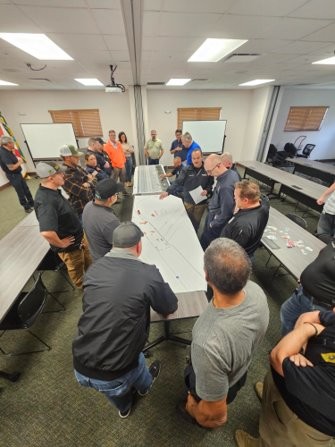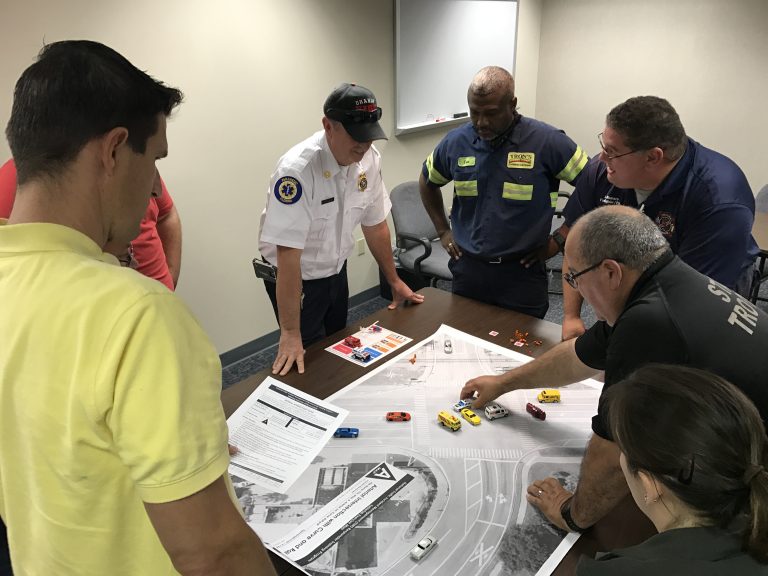
Every minute of every day, incident responders place themselves at risk while responding to traffic incidents. The four-hour National Traffic Incident Management (TIM) Responder Training course provides responders from all disciplines with the knowledge and skills needed to safely, effectively, and efficiently manage and clear roadway incidents.
This training is provided for FREE by FDOT!
Traffic incident responders include emergency medical services, transportation and public works personnel, fire and rescue agencies, law enforcement, towing and recovery professionals, and others who support traffic incident management operations.
Effective incident response depends on seamless communication, coordination, and collaboration among all responding disciplines. By working together, responders can provide timely assistance to those who are injured, protect responders and roadway users, restore normal traffic conditions as quickly as possible, and reduce the risk of secondary crashes.
The National TIM Responder Training course covers notification and scene size-up, safe vehicle positioning, scene safety, command responsibilities, traffic management, special circumstances, and clearance and termination. Upon completion of the course, participants will be able to:
- Use a common set of practices and advance standards across all responder disciplines.
- Be equipped with a set of core competencies and strengthen TIM programs in the areas of responder safety; safe, quick clearance; and prompt, reliable, and interoperable communications.
Why take the 4-hour National TIM Responder Training course? Because it works. The benefits from this training can be multifold, saving lives, time, and costs associated with incidents.
The target audience for the training is any TIM responder or TIM support professional, including emergency management, emergency medical service, fire and rescue, law enforcement, public works, towing and recovery, transportation safety service patrol, traffic management center, and public safety dispatch at State, regional, or local levels.
Saving Lives
- TIM-trained responders can learn how to safely clear incidents while reducing their traffic exposure risks. The training can help save traffic incident responders’ and motorists’ lives.
- TIM-trained responders clear incidents more quickly, thereby reducing the likelihood of secondary crashes, which can be more severe than the initial incident.
Saving Time
- Response techniques taught in this course can help reduce the time each responder spends at the incident scene, enabling them to get back to other duties more quickly.
- The training also can help responders understand the unique duties of each responder community and work collaboratively to save motorists time spent in traffic.
Saving Money
- Fewer secondary crashes save responder equipment and reduce insurance claims for all parties (motorists and responders).
- Shorter incidents mean less congestion and fewer freight and motorist delays.
- Faster cleanups lead to cost savings for incident personnel.